 seedthink.ai
Engineering · Seedthink
The Nine Graph Agents
A Seed does not only grow when you teach it. Every night, and on demand, a set of deterministic agents reorganise everything a Seed knows — recomputing trust, hunting contradictions, connecting related facts, clustering topics, compressing duplicates, and deciding how mature the Seed has become.
August 15, 2026 · Seedthink
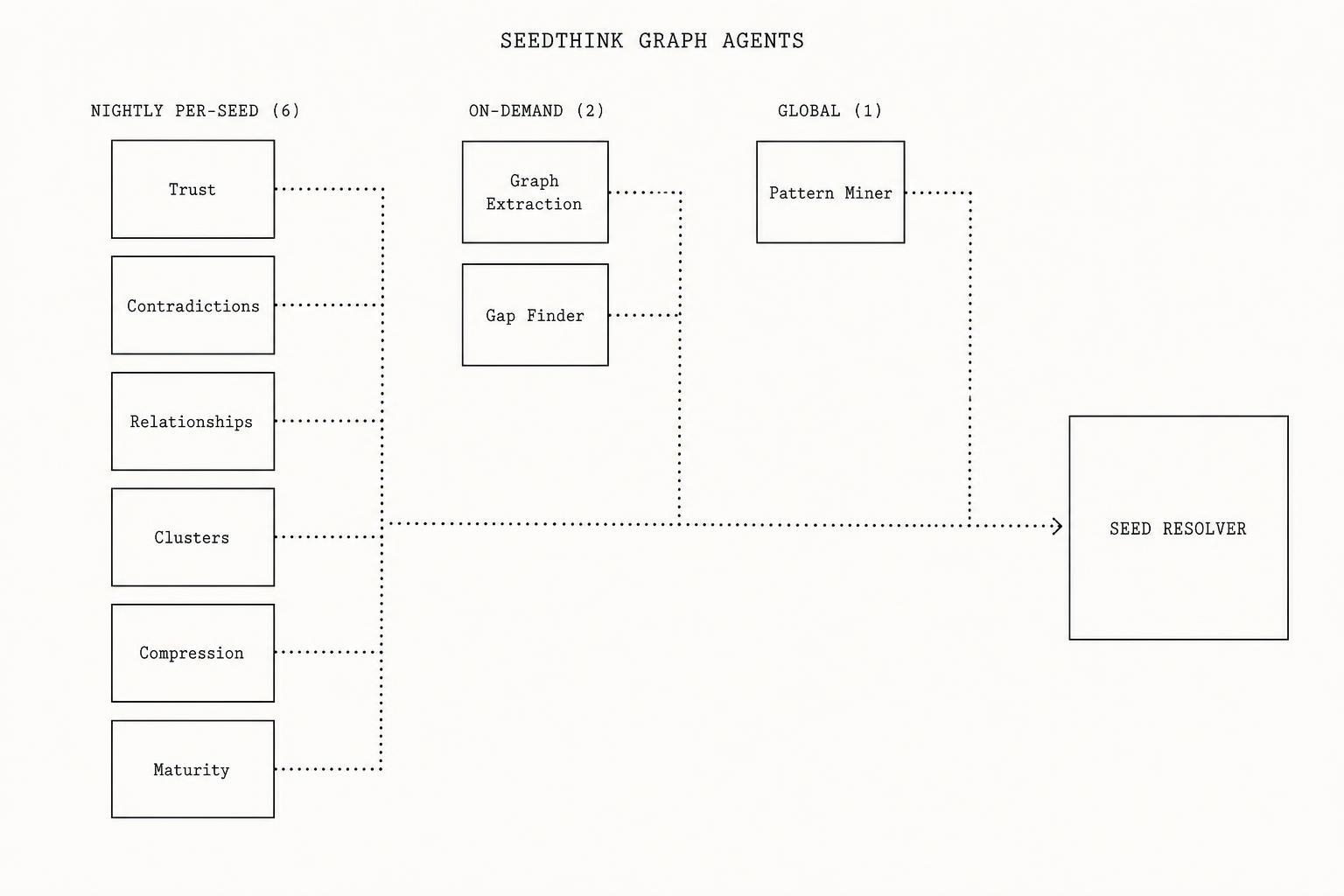
Six nightly per-Seed agents
These run once per night across every active Seed. They use zero LLM tokens — they work deterministically on data already in the database, which is what makes continuous growth affordable.
- Trust recompute — recalculates the confidence of every fact and edge from source quality, corroboration, age, and how often the fact has been used successfully.
- Contradiction hunter — finds facts that conflict with each other and flags them for verification instead of letting both answers coexist silently.
- Relationship builder — creates fact-to-fact edges so the graph can be traversed rather than only searched.
- Cluster finder — groups facts into topic clusters, which is how a Seed knows what it is actually about.
- Compression — merges near-duplicate facts and archives the redundant copies, keeping full traceability.
- Maturity engine — scores coverage, verification rate, and graph density to move the Seed through its stages (seedling, young, established).
Two on-demand agents
These run when you act, from the Seed's Build workspace.
- Graph extraction — reads verified facts and extracts subject–predicate–object triples into the Knowledge Graph. This is the one agent that uses a model, and it pages through facts so growth never stalls on an early batch.
- Gap finder — inspects clusters and edges to identify what the Seed is missing, then proposes concepts you can accept and teach.
One global agent
The pattern miner works across the whole platform rather than inside a single Seed. It looks for reasoning patterns that repeatedly produced good outcomes and promotes them into shared patterns, so a new Seed inherits proven structure instead of starting from nothing.
How it is scheduled — and how failures surface
The nightly pass, the autonomy tick, and corpus maintenance are triggered by scheduled calls to signed hook endpoints. Each call is authenticated with a vault-backed bearer token and each run is recorded, including rejected calls. If a scheduler stops working, the run log shows it instead of the graph quietly going stale.
Why it matters at query time
Everything these agents produce feeds the Seed resolver. When you ask a question, the resolver tries the Seed's knowledge graph, then its memory graph, then its reasoning graphs and distilled tiny model — and only falls back to a generic teacher model when the Seed has not grown enough to answer on its own. Every nightly pass therefore shifts a little more of the answering work from a generic model to your own verified intelligence.
That shift is the whole point. A static index degrades from the day it is built. A Seed gets denser, better connected, and more self-sufficient every night.